Epigenesis
The Old AxolotlEpigenesis is the gap between preserving a genetic blueprint and reproducing the life that develops from it. In the story, it explains why identical DNA may yield different organisms, and becomes Bartek’s sleepless concern about how the childhood of humanity’s newly synthesized children could shape generations to come. The concept connects the practical work of rebuilding life after The Extermination to a larger uncertainty: inheritance carries more than a sequence, but its full contents resist precise control.
Definition and Mechanism
Epigenesis evades complete technical analysis. Jarlinka explains that researchers can begin with exactly the same DNA and develop it under exactly the same conditions yet still end up with different organisms. The genome alone, then, cannot account for every difference in the resulting life. The account distinguishes the genes themselves from the patterns of gene expression: which genes activate, which remain inactive, and when those changes occur.
Those patterns, as Jarlinka describes them, are stored outside DNA in a stream of intergenerational memory. Histones provide one example. DNA wraps around these proteins, but the shape of the histone affects the shape of the wrapped DNA, so having the same genes does not ensure that they will be organized in the same way. Jarlinka also points to methylation, which imprints DNA with aspects of a person’s life, including trauma, illness, material circumstances, education, residence, and the air they breathe. Her examples extend to hereditary environmental expressions. Together, they present inheritance not as a sequence passed forward untouched, but as a biological history shaped by conditions and carried across generations.
Reconstructing Life
The problem matters because Project Genesis is rebuilding organisms after almost all organic compounds have been destroyed. Frances explains to Bartek that the reconstruction need not repeat the entire emergence of organic life from primordial chemistry. The chemical building blocks and the capacity to synthesize nucleotide chains already exist, as do precise DNA maps from the Human Genome Project. Eggs must also be synthesized and wombs prepared in incubators, but Frances says that technology existed before The Extermination and still exists.
The recovered genetic record, however, does not make every revival equally possible. Before The Extermination, scientists had not precisely recorded or archived species that were not threatened with extinction; for species already extinct, obtaining biological material was difficult. The strongest candidates for revival were species that had been nearing extinction, because scientists had recorded both DNA packages and complete epigenetic recipes. The Axolotl, already on the fast track to extinction, was among those candidates. Vincent Cho had used it as one of the first animals in his resurrection experiments. Its return therefore depends not only on a recoverable genome but on a record of the developmental inheritance that accompanies it.
Bartek’s Investigation
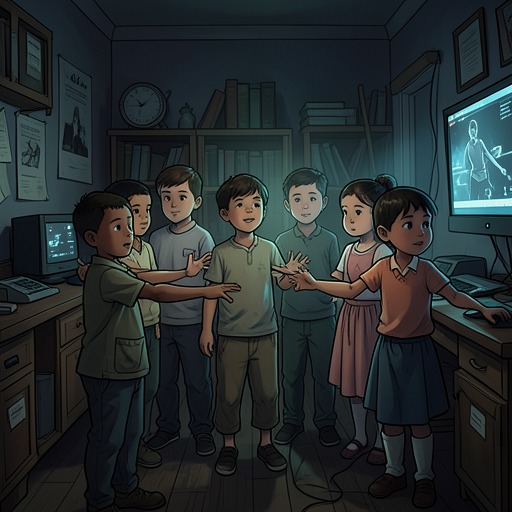
Epigenesis keeps Bartek from sleeping. Unable to resolve the problem by resting, he watches thousands of hours of recordings from Paradise, from before The Extermination, and from the lives of the second humans produced through Vincent Cho’s synthesis method. He compares children and children, life and life, and games and laughter, looking for a difference that will explain why outcomes diverge. The scale of the comparison does not deliver a clear answer: he cannot tell whether the cause lies in some overlooked difference between the recorded lives or in the deeper distinction between human beings and transformers.
That uncertainty gives the concept an immediate personal and historical reach. Bartek is not merely asking whether a DNA sequence can be copied; he is trying to understand what else must pass between generations for their lives to resemble one another. The recordings provide abundant evidence of particular childhoods, but no technical procedure that turns observation into a complete account of epigenesis. The question remains open even as the children’s future approaches.
Childhood and the Future
Bartek sees the consequences extending beyond the present children. In a few years, he predicts, they will multiply and raise their own children, and the experiences of this first generation will be copied through generations to come. He compares that possibility to a microscopic quantum irregularity after the Big Bang: a tiny initial difference capable of determining the later shape of galaxies and clusters. In the same way, he argues, a few years of games, lullabies, nannies, fairy tales, punishments, and rewards could determine the shape of Humanity 2.0 and beyond.
This comparison shifts epigenesis from a problem of biological replication to one of formative experience. The details Bartek names are not grand institutions or deliberate genetic alterations; they are the ordinary arrangements of childhood. Their consequence, in his view, may be cumulative and immense. Jarlinka responds to his worry by telling him to go and play with the children. The answer offers no technical solution to epigenesis. Instead, it directs Bartek toward the very experiences he fears will matter: childhood is not only something to analyze after the fact, but a living context in which the next generation is being formed.